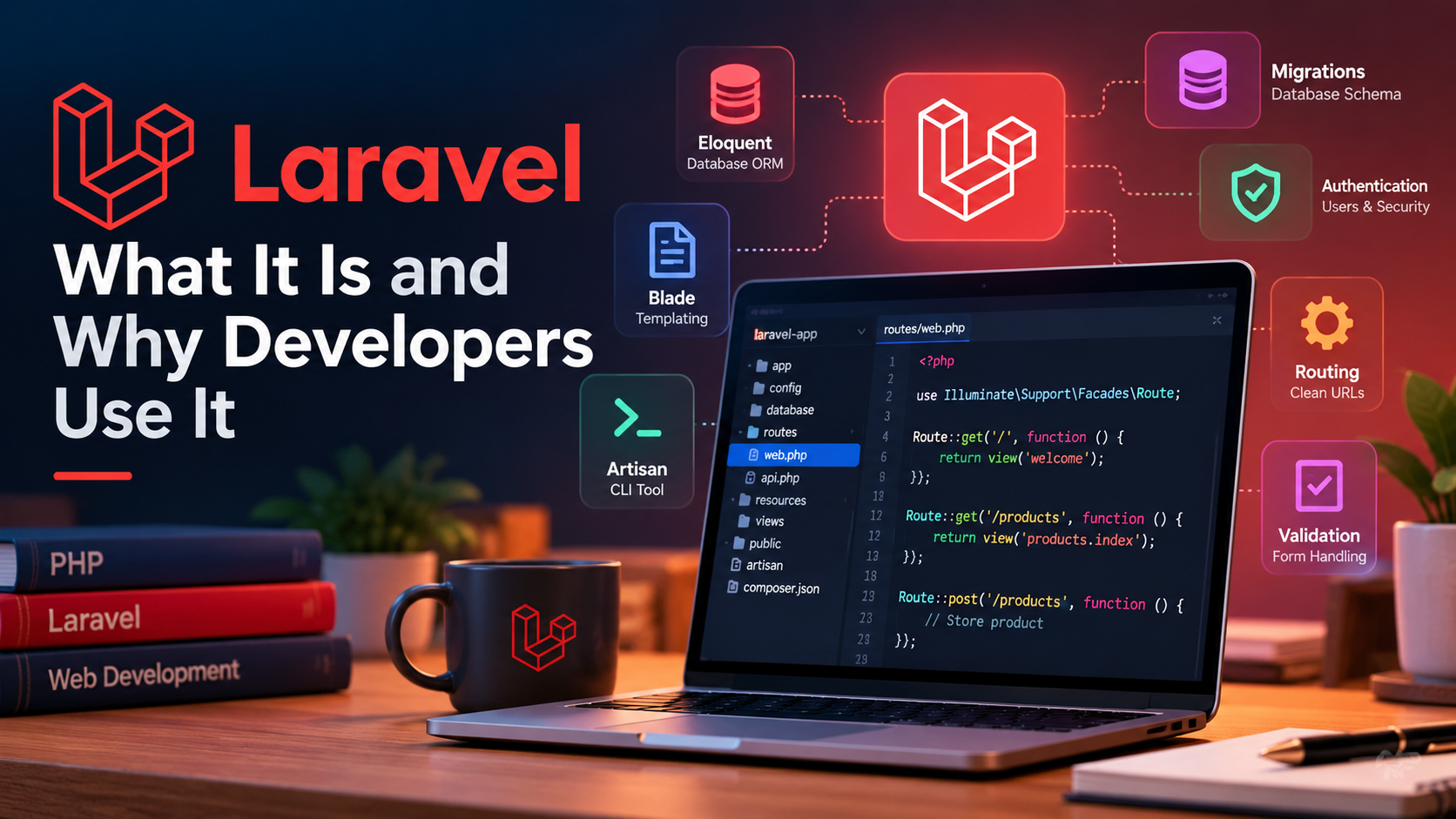
Laravel is an open-source PHP framework first released in 2011 by Taylor Otwell. Rather than being a product in its own right, it's a set of tools and conventions that sit on top of PHP, handling the repetitive parts of building a web application so a developer can focus on the parts that are actually specific to their project.
What a Framework Is Doing For You
Every web application, regardless of language, ends up needing the same basic plumbing: a way to route incoming requests to the right piece of code, a way to talk to a database, a way to render pages, a way to handle user sessions and authentication, and a way to validate input. Writing all of that from scratch for every project is slow and error-prone. A framework provides these pieces already built, tested, and consistent with each other, so a developer is assembling an application rather than constructing its foundations every time.
Laravel follows the Model-View-Controller (MVC) pattern, which separates an application's data handling (models), its presentation (views), and the logic that connects the two (controllers). This separation is common across many frameworks in many languages, not unique to Laravel or PHP.
What Laravel Specifically Provides
- Eloquent, an object-relational mapper (ORM) that lets developers work with database records as PHP objects rather than writing raw SQL for every query.
- Blade, a templating engine for building HTML views with reusable layouts and components.
- Artisan, a command-line tool for common tasks like generating boilerplate code, running database migrations, and managing scheduled jobs.
- Migrations, a way to define and version database schema changes in code rather than manually editing a database.
- Built-in tools for authentication, routing, form validation, queued background jobs, and testing.
Why Developers Choose It
Laravel is frequently chosen because it reduces the amount of repetitive code needed to get a working application off the ground, while still allowing a developer to drop down into plain PHP when needed. It has a large ecosystem of official and community packages, extensive documentation, and a large enough user base that most problems a developer runs into have already been discussed somewhere publicly.
It isn't the only PHP framework, and it isn't automatically the right choice for every project — a very small script or a simple static site doesn't need a full framework, and Laravel's conventions can feel like overhead on something that small. But for applications with real data models, user accounts, and ongoing feature development, it's a common and well-supported starting point in the PHP ecosystem.