It's tempting to treat game trade-in as electronics buyback with cheaper items. Same rough idea -- customer offers something used, business quotes a price, device or disc changes hands for money. In practice the two problems point in opposite directions, and a platform built for one doesn't naturally fit the other.
Electronics buyback: one item, many conditions
A phone buyback business deals with a relatively small number of distinct products -- a given iPhone model only comes in so many storage/colour combinations -- but each unit can be in wildly different physical condition. The hard problem is condition assessment: cracked screen, battery health, water damage history. The catalogue itself is short and stable.
Game trade-in: thousands of items, mostly binary condition
A game trade-in business faces the reverse shape. Physical condition barely matters beyond "does the disc play" -- there's no battery health curve, no screen to crack. What's hard instead is the sheer size and churn of the catalogue: thousands of titles across multiple platforms, regional variants, special editions, and re-releases, all of which need to be correctly identified before a price can even be looked up. Get the title wrong -- mix up a standard and a Game of the Year edition, or the wrong regional SKU -- and the quoted price is wrong before condition even enters the conversation.
Why this makes identification the actual product
This is the part that's easy to underestimate if you're used to thinking about buyback as a pricing problem. For games, the pricing lookup itself is usually trivial once you know exactly what item you're looking at. The friction is entirely upstream: getting from "customer has a physical disc in a case" to "confirmed catalogue entry" quickly enough that trading in a stack of games doesn't feel like data entry.
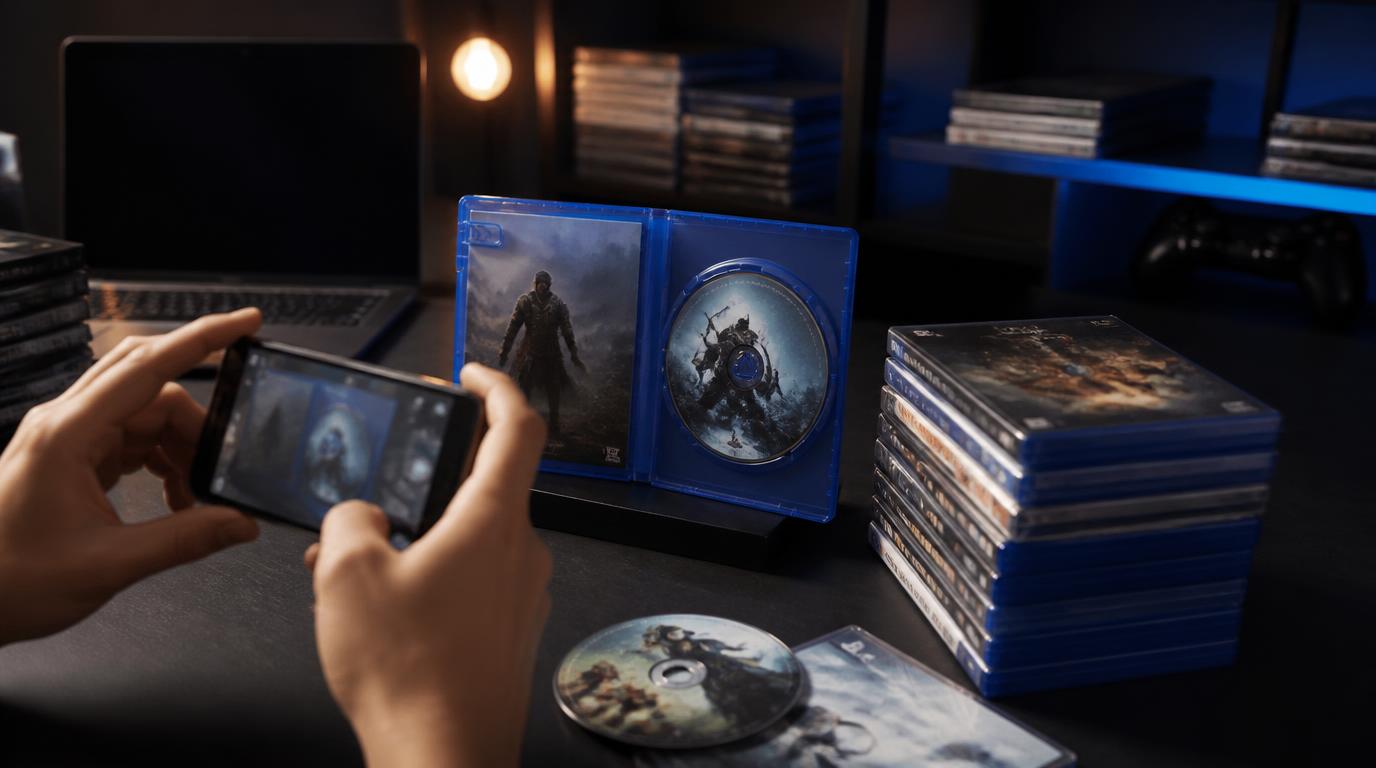
This is where photo-based identification genuinely earns its place, rather than being an AI feature bolted on for its own sake. A photograph of a game case, matched against a reference catalogue, can resolve title, platform, and edition faster than a customer manually searching a dropdown -- particularly for a customer trading in ten or twenty titles at once, where manual entry is where people give up partway through.
What AI identification does -- and deliberately does not do
It's worth being precise here, because "AI-powered trade-in" gets used loosely. Identification matches a photograph to a catalogue entry. It does not set the price. Pricing stays merchant-controlled: the business decides what a given title in a given condition is worth to them, based on their own resale market and margins. The AI's job ends at "this is Title X, Platform Y, Edition Z" -- everything from there is the same manual pricing logic a business would apply to any catalogue match, whether the match came from a photo, a barcode scan, or a manual search.
That distinction matters for trust as much as for accuracy. A customer should be able to see that a business set its own trade-in values, not that an algorithm decided what their game was worth.
Barcode vs. photo -- where each genuinely helps
Barcode/EAN scanning is faster and more reliable when a case is intact and the barcode is legible -- it's a direct catalogue lookup with very little ambiguity. Photo identification earns its keep for the cases barcode scanning can't handle well: damaged or missing barcodes, loose discs without their case, or a customer trading in from a phone camera rather than a dedicated scanner. A trade-in platform that only supports one of the two is solving half the friction.
The takeaway for anyone running or evaluating this
BuyBackEmpire Games is built around this specific shape of problem -- fast, accurate catalogue matching across a large and constantly changing title list, with pricing left entirely in the merchant's hands. If you're comparing trade-in platforms, the question worth asking isn't "does it have AI" -- it's how fast and accurately it gets from a customer's photo to the correct catalogue entry, across the messy real-world cases (no barcode, wrong case, regional variant) that make up more of the volume than anyone expects going in.