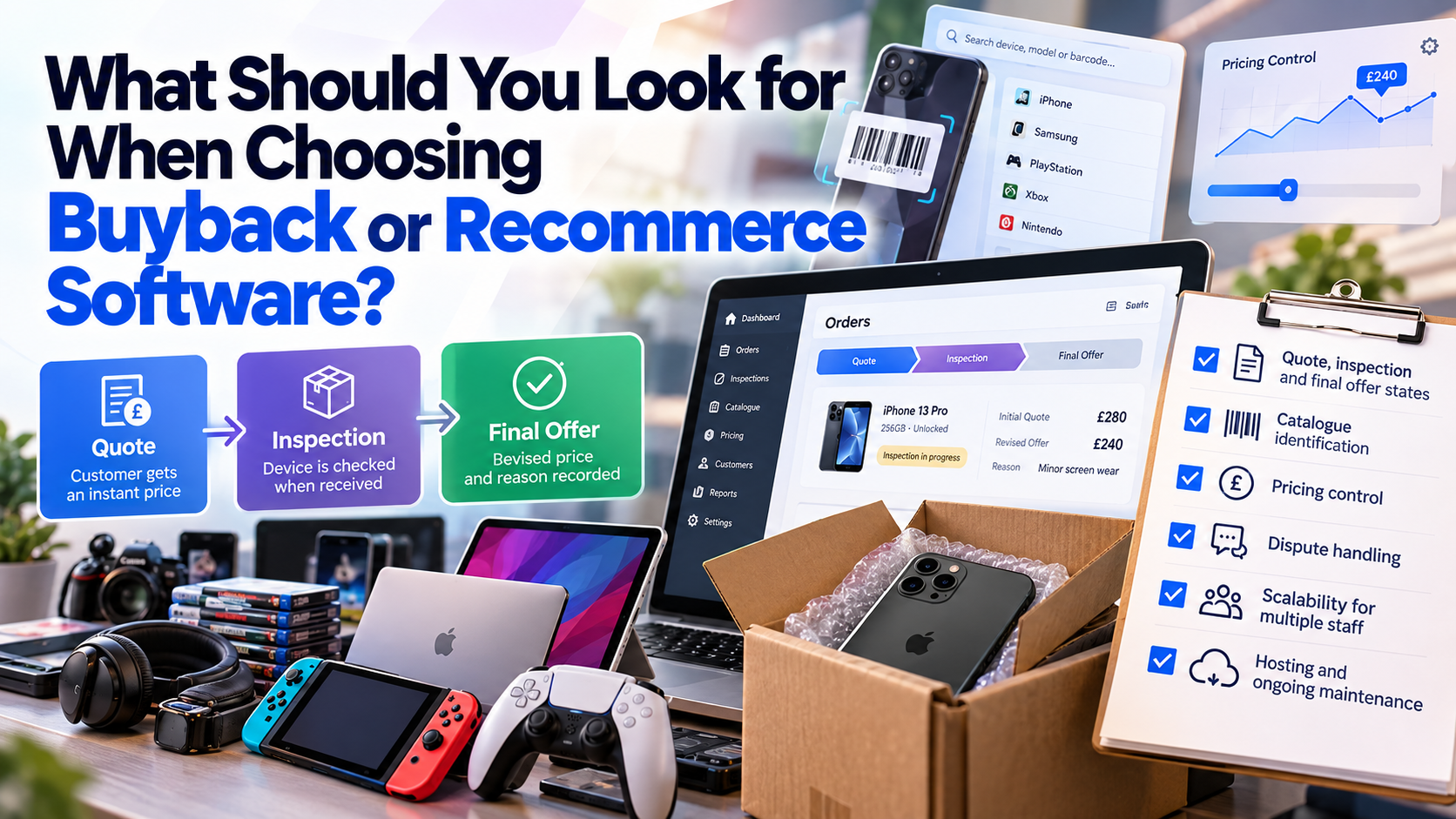
A buyback or recommerce platform demo tends to show the easy path: a clean quote form, a nice price, a smooth checkout. That's the 10% of the system that's simplest to build and easiest to show off. The questions worth asking before committing to a platform are almost all about the 90% that a demo doesn't naturally surface.
Does it separate quote, inspection, and final offer as distinct states?
This is the single most important structural question, and it's covered in more depth in our piece on how buyback businesses actually work. If a platform treats the initial quote as final and has no built-in way to record a revised offer with a stated reason after physical inspection, every disputed device becomes a manual, off-system conversation -- which doesn't scale past a handful of trades a week.
How does it handle catalogue identification, and does that match your product type?
Electronics buyback and game trade-in have different catalogue shapes -- see our comparison of video game trade-in vs electronics buyback for why. If you're evaluating a platform for a catalogue with thousands of SKUs (games, media, collectible electronics), ask specifically whether it supports photo-based or barcode identification, not just a manual search box. A manual dropdown search is fine at low volume and becomes the main source of customer drop-off once someone is trying to trade in more than a handful of items in one session.
Who controls pricing -- and is that actually true, or just marketed that way?
Ask directly whether the platform's pricing engine is fully merchant-controlled, or whether an "AI" or "smart pricing" feature is quietly setting values the business can't fully override. There's nothing wrong with automated suggested pricing as an input, but a platform that can't be pinned to explicit, merchant-set values for every catalogue entry puts a business in the position of not fully knowing what it's offering customers until a quote is generated.
What happens when a customer disputes an outcome?
Every buyback business will eventually face a customer who disagrees with a revised offer or a rejected device. What matters is whether the platform gives staff a clear, auditable trail -- what was declared, what was found, what changed -- to resolve that dispute quickly, or whether staff are reconstructing the history from memory and email threads. This is invisible in a demo because a demo doesn't include a disagreement.
Does it scale past a founder manually checking everything?
A platform that works well when one person is personally reviewing every inspection doesn't necessarily work once inspection is handled by multiple staff, or once volume is high enough that inconsistent judgement calls between staff become a real problem. Ask how the platform supports consistent inspection criteria and staff permissions, not just whether it technically allows more than one login.
What ongoing maintenance and hosting does it actually require?
A platform marketed as "software you own" that still requires ongoing hosting management, security patching, and infrastructure decisions isn't meaningfully different from a from-scratch build in terms of ongoing overhead -- see our piece on ready-made vs custom-built business software for the fuller version of this tradeoff. A genuinely managed platform should mean the operational maintenance burden sits with the provider, not quietly with you after the initial setup.
The honest summary
None of these questions have a universally right answer -- they depend on your catalogue type, your volume, and how much operational control you want to retain versus hand off. But asking them before signing up avoids the common failure mode: choosing a platform based on how good the quote form looks, and discovering the actual gaps only once real customers, disputed inspections, and catalogue edge cases start arriving.